The Town That Became Home: A Love Story with Route 66 and Flagstaff
It was early March 1961.
After spending the first five months of our married life in Washington DC, Ron had finished his military tour of duty and we were on our way home to California. For me it meant a new life in an unfamiliar place with an almost-brand-new husband — and a sense of adventure I couldn’t quite contain.
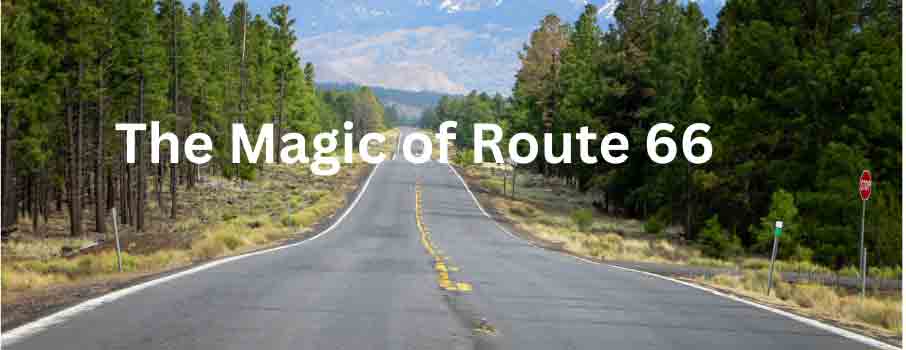
After a detour to Florida to visit my family we picked up Route 66 in Texas. That was more than sixty years ago. The memories are still clear as glass.
The changes started at breakfast. The southern grits I had grown up with disappeared, replaced by hash brown potatoes. Then the scenery began to shift — flatter, drier, more open than anything I had known growing up in Pensacola. I was excited to see my first real mountains, my first national parks, the landscapes I had only ever read about in books.
We were driving a 1960 Morris Mini Minor — a tiny English car, one of the first front-wheel drive vehicles ever manufactured, barely large enough for two people and their luggage. Foreign cars had only recently begun appearing on American roads and ours attracted curious looks everywhere we stopped.
In New Mexico we left the highway to visit ruins on the Navajo Reservation. Ron got out to take photographs and I waited in the car. Without warning the little Morris was surrounded by an enormous herd of sheep — baaing and stumbling over each other as they pushed their way up the road around us. I had never seen sheep before in my life. I was genuinely terrified.
Ron and the Navajo sheepherder had a good laugh at my expense that day.
In Arizona we stopped at Meteor Crater. I had read about it but nothing prepared me for the actual size of it. In those days you could walk a trail all the way down to the bottom — which we did, despite the fact that I was from completely flat country and was frightened with every step of slipping on the rocky terrain. Ron kept reassuring me and patiently taught me how to walk on steep ground.
I still didn’t enjoy that hike.
The Mountain That Stopped My Breath
Just outside Flagstaff we stopped at Walnut Canyon National Monument. Standing at the visitor center window I looked out and saw the San Francisco Peaks for the first time — towering and snow-capped against a blue Arizona sky. It took my breath away completely. I had seen the Smoky Mountains on my honeymoon but nothing had prepared me for a mountain like that.
That image is still etched in my memory more than sixty years later.
Flagstaff was a small town then. From Route 66 it looked like any other wayside stop — motels arranged like dominoes along the main road, diners, gas stations, the Burlington Santa Fe Railroad tracks dividing the town in two. Easy to pass through without a second look.
But something about it lingered.
The town had been born of a railroad in the late 1800s — named, as the story goes, when a group of travelers celebrating the country’s centennial on July 4th, 1876 stripped a tall pine tree of its branches and ran up an American flag. When the holiday ended they moved on, but the bare flagpole remained. When the railroad arrived a few years later and the place needed a name, someone suggested Flagpole. Someone else said Flagstaff sounded better. They agreed, and Flagstaff was born.
Nestled at the base of the ancient San Francisco Peaks and surrounded by the world’s largest ponderosa pine forest, it offered something that Route 66 couldn’t show you from the road — a particular magic that revealed itself only to those who stopped long enough to look past the main street.
I was charmed. But I was also a young bride on her way somewhere else, and we drove on.
The Town That Kept Calling
We crossed that route again several times in the years that followed, visiting my family in Florida, and we always stopped in Flagstaff. It never lost its pull.
Ron eventually became a Forester with the US Forest Service. On one of those later trips we stopped at the Flagstaff Forest Service office and asked someone about living there.
“You don’t want to live here,” she told us. “It’s much too windy.”
She wasn’t entirely wrong. It is windy. But we didn’t let that stop us. When the opportunity came, Ron applied for and received a transfer to Flagstaff. That was more than forty years ago. Our daughters grew up here, attended the local university, and still make their lives in northern Arizona today.
I built and grew an internet business here. I raised my family here. I lost my husband here — and stayed, because leaving was never a thought that made any sense.
Over those decades we watched Interstate 40 completed and Route 66 fade from a major highway into something quieter — a nostalgia trip, a stretch of road that communities like Williams, Winslow, Holbrook, Kingman, and Seligman have worked hard to preserve. Those towns understood something important: that history and the memories attached to it are worth fighting for.
Flagstaff has grown and changed in ways that are complicated — the university expanding, historic downtown features giving way to modernization, the small-town feel harder to find than it once was. But the mountain is still there. The ponderosa forest is still there. The magic that stopped a young bride’s breath at a visitor center window in 1961 is still entirely intact.
The San Francisco Peaks are no longer a memory I carry. They are the view from my daily life.
I first passed through this town sixty-three years ago on my way to somewhere else, with a man I was still getting to know, in a tiny English car that sheep found fascinating.
I never really left.
And I hope I never do.