
Share Those Memories Before They Are Gone
They will disappear with you!
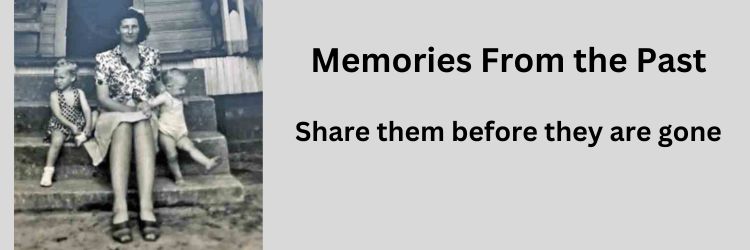
My mother made my dresses from chicken feed sacks.
Not because she was creative — though she was — but because there was nothing else. Money was tight and the feed companies printed their sacks with cheerful patterns specifically for that purpose. When my mother bought feed for the chickens, she searched carefully for designs that matched ones she already had, because it usually took more than one sack to make a dress for a little girl.
This is one of the memories I carry from a few years of early childhood spent in Perdido, Alabama during World War II. My father had been drafted into the Navy and sent to the Pacific. My mother took my sister and me to live with our grandparents on their forty-acre farm in this tiny rural town in southern Alabama.
Ginger and I were very young. Many of the hardships of that time probably didn’t register as hardships because we knew nothing else. This was simply life.
And what a life it was.
We huddled close to a small fire built in an open fireplace — one of two fireplaces that provided the only heat in the uninsulated old farmhouse. In the kitchen stood a wood-burning iron cookstove that produced the best chicken and dumplings and the crispiest biscuits I have ever tasted in my life.
Drinking water stood in a large white enamel bucket on top of the open cabinets, with an enamel dipper beside it. That water was precious. It had been drawn up from an open well in the front yard using a rope and hand-turned pulley — a small wooden shed built over the opening just wide enough for the bucket to pass through.
My grandfather had asthma and was very ill by the time we arrived, unable to do much around the farm. So the large garden that fed us through summer and filled the cellar through winter was my grandmother’s and mother’s responsibility. They fed the chickens that roosted in the yard. They kept everything running. The remaining forty acres had been leased to a neighboring farmer who grew cotton.
Nearby stood the two-seater outhouse with pages from an old Sears Roebuck catalog serving as paper. When it was too dark to navigate safely past the rattlesnakes or too cold to venture outside, we used the slop jars kept under the beds in each bedroom and emptied each morning.
We went to bed early — not only because we were tired but because it was dark. If my mother wanted to read by kerosene lamp she could, but kerosene had to be purchased and was used sparingly.
The town of Perdido was small: an elementary school, a post office, a Masonic lodge, a Baptist church, a Methodist one, and two small general stores. We walked to town frequently — for canned milk, for flour, for necessities we couldn’t grow — but mostly because my mother was waiting for letters from my father.
Before he shipped out they had sat together with a map and numbered the Pacific islands. His letters would be censored and he couldn’t say where he was. So he would refer casually to something they both knew wasn’t true, slipping in a number that was their private code for the island his ship was near. My mother would read those letters and find him on the map and know, for a little while, exactly where he was.
When we needed something Perdido couldn’t provide we took the train to Atmore — a larger community several miles away. We used ration books to buy the one pair of shoes allotted to each person per year. I remember my pair particularly well: white high-top shoes that I promptly removed when we got home so I could play barefoot on the back porch.
The dog found them and chewed them.
My grandfather gave my mother his shoe ration so she could replace mine. He went without new shoes that year so his granddaughter could have a pair.
I have never forgotten that.
In today’s world of flush toilets and light switches and thermostats and water that flows from a tap, these memories seem almost unreal — like stories from another century, which of course they are. But they are mine. The specific weight of that enamel dipper. The smell of kerosene. The coded letters arriving at the post office. My grandfather’s quiet sacrifice.
When I die these memories die with me unless I write them down.
So I’m writing them down.
Each of us carries a world of experience that exists nowhere else. Memories triggered by a smell, a taste, a particular quality of light on an afternoon. They are ours to recall, to savor, and to pass forward.
Don’t let yours disappear with you.
Write them down. Tell someone. Leave a trace.
The chicken feed sack dresses were beautiful, by the way. My mother made sure of that.